For those unfamiliar with the history (I promise I will be brief!), Japan had a deeply-entrenched anti-western view. During the Edo (or Tokugawa) Period, which lasted from about 1600 to the mid 1800s, the Japanese aristocracy and monarchy resisted western cultural influence and trade. This was done for a number of reasons, both altruistic and self-serving, all of which are very interesting as to their ramifications. Suffice it to say that the Japanese valued their culture, religion, and tradespeople/artisans to a much higher degree than anything ever seen in the west. The Japanese were successful in keeping out foreigners to a large degree. It wasn't until Admiral Perry and his rather forceful insistence that the Japanese open their markets to foreign trade (somewhere, Karl Marx was shaking his head) that exchange between Japan and the west began in earnest. It also took the efforts of Emperor Meiji (for whom the period is named), who adopted extreme measures to not only open markets to western products and trade but also to embrace western culture, with all that that entails.
In Kokoro, Soseki explores the loss of Japanese culture. He points out that although modern society has a lot of convenience and ease, and that many people are able to live in close proximity, that people are not necessarily happier, and they experience profound loneliness - the loneliness of the crowded place, the isolation of the metropolis.
The question remains, then: have things improved? 100 years from the publishing of the book, are things any better?
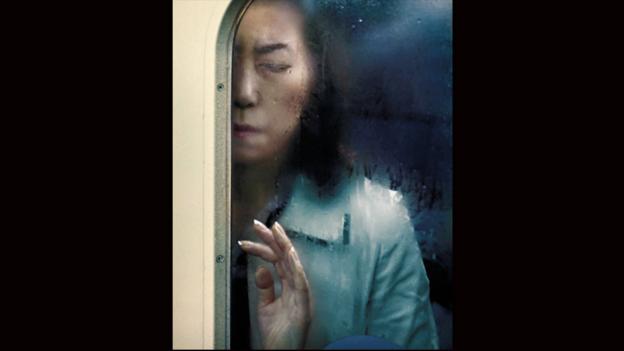
This morning I read/reviewed images related to the phenomenon. This one in particular grabbed my attention:
To me, this typifies the experience and feel of what I noted above about the loneliness of the crowded place, or the isolation of the metropolis. It is possible to be crushed by humanity to the point that one's individuality becomes nondescript and insignificant, except, of course, to the individual.
I have been on trains like this. I have felt the station workers pushing my back as they crammed me into a crowded train car. I have heard the grunts and gasps as people wedge into the spaces. And I have heard (not heard?) the silences that attend such occasions. The avoidance of eye contact. The smell of sweat and fabric softener and bad breath and coffee, hanging like a fug above the heads of the passengers. I have felt bodies of strangers I would never see again pressed up against mine, lurching as the train jerked to a start and stop. The cool rush of clean air coming into the compartment as the doors open at the station, letting a few people on to replace the ones who got out.
It's unbelievable. It's nearly impossible to describe. And it happens every day.
More to the point, I once observed two young girls walking home from school. Based on their uniforms, they attended the same school. Based on their ultimate destination, they lived in the same high-rise apartment complex. But one was 20 feet in front of the other, and they didn't know each other. It was strange, surreal. And yet, it was real. Very, very real.
As a planner, I feel it is my responsibility to counter some of these forces. Of course, we don't have the same kinds of issues with crowding that they do in Asia. But the questions surrounding the idea of how to make a community more inclusive, how to make it feel like home, like a place people of all kinds want to live and play and work and just be... These are all very important to me. Where do people gather? What makes them come back to a place after they've been away for years? What is the source of the connection to a community? Surely it lies in the collective experience of people (individually and collectively) with a place. It's this attitude that gives people not only a connection to the place, but makes them feel invested in the place, wanting to stay and help it grow and succeed. And this is what is interesting to me.